
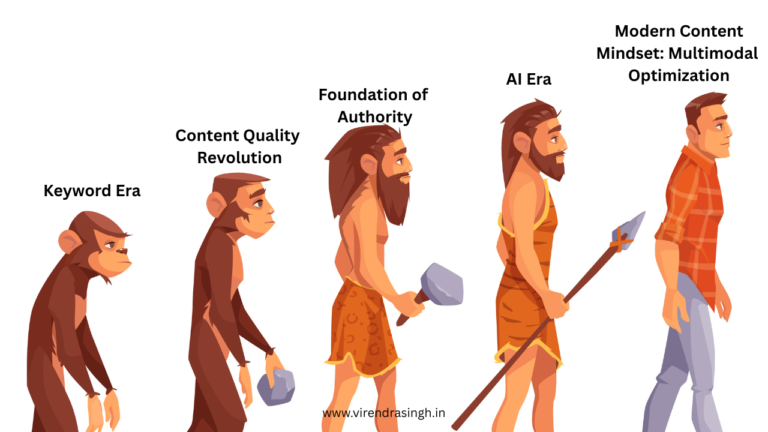
The field of Search Engine Optimization (SEO) continues to stay strong because it keeps evolving with search engines’ main goal of delivering the most helpful and reliable results. SEO isn’t outdated, it has simply grown into a more advanced practice where strategy supports one key purpose: creating high-quality, trustworthy content.
Over time, SEO has shifted from focusing only on search engines to truly adding value for real readers. Major algorithm updates have pushed this change, encouraging creators to focus on relevance, expertise, authority, and genuine experience.
1. The Keyword Era: Manipulation and the First Algorithmic Retaliation (Pre-2011)
1.1 The Birth of Relevance and the Keyword Stuffing Trap
When Google launched in 1998, its foundational algorithm, PageRank, revolutionized search by prioritizing incoming links and their quality as a measure of a website’s credibility.
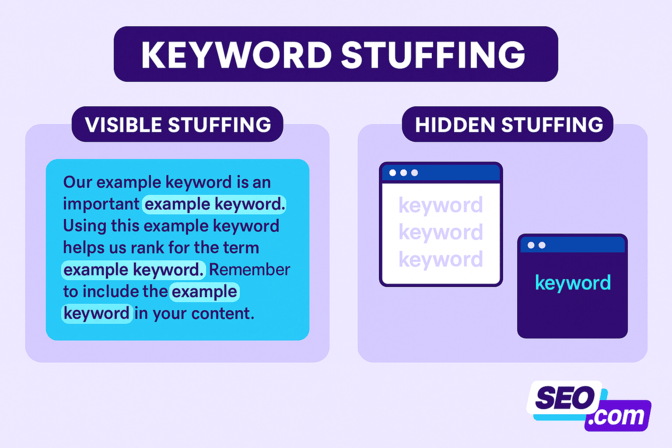
This initial focus, combined with counting keywords on a page, prioritized certain technical elements. In the starting era of SEO, this led to a massive exploitation known as keyword stuffing, where marketers execute and focus on keyword density instead of helpful content.
Many used to stuff keywords into their content, sometimes even hiding them to boost rankings, often at the cost of readability and user experience.
1.2 Algorithm Retaliation: The Florida Update (2003)
Search engines quickly responded with updates aimed at improving content quality. Google’s Florida Update in 2003 was one of the first major algorithm changes targeting keyword stuffing and manipulative SEO tactics.
This update penalized websites that relied on low-quality strategies, setting a key precedent while such tactics might offer short-term gains, Google’s evolving algorithms would always prioritize relevance and user experience in the long run.
It marked the start of a lasting pattern: every attempt to exploit the system is eventually countered by smarter algorithms built to reward genuine, high-quality content.
Focus:
- Targeted manipulative SEO tactics like keyword stuffing, invisible text, and link schemes.
- Aimed to clean up low-quality affiliate sites and doorway pages.
Impacted Areas:
- Affiliate marketing websites
- E-commerce sites using aggressive keyword optimization
- Thin content or doorway pages
Estimated Impact:
- Roughly 50%–60% of highly optimized websites saw ranking drops.
- Many small businesses (especially in travel, fashion, and retail niches) lost major traffic right before the holiday season.
2. The Content Quality Revolution: Algorithms Learn to Read Intent (2011–2019)
The period spanning 2011 to 2019 marks the decisive end of keyword stuffing as a viable SEO strategy, as Google implemented major updates designed to understand content at a human level.
Content-Focused Google Algorithm Timeline
| Update Name | Approx. Date | Primary Content Focus | Goal/Impact on Content |
| Florida | 2003 | Keyword Stuffing, Spam | Initial penalty for manipulative tactics; focus on relevance |
| Panda | 2011 | Low-quality, thin, duplicated content | Penalized “content farms,” boosted original quality and comprehensiveness |
| Hummingbird | 2013 | Semantic Meaning, Context | Understood user intent and conversational search; moved beyond exact keywords |
| RankBrain | 2015 | Query Interpretation (Machine Learning) | Enhanced intent matching; content must solve user problems thoroughly. |
2.1 Landmark 1: The Panda Update (2011) — Targeting Low-Value Content
Google’s Panda Update (2011) targeted “content farms” sites filled with thin, duplicated, or low-value material created only to rank in search results. The impact was immediate and widespread. Many websites were hit hard, with some losing up to two-thirds of their organic visibility, forcing webmasters to audit and either improve or remove poor-quality pages.
Panda made one thing clear: originality and depth weren’t optional, they were essential. It shifted SEO from quantity to quality, setting a new standard for meaningful, well-researched content.
This update also laid the groundwork for modern algorithms that assess context and relevance, not just keywords. As SEO expert Carolyn Lyden put it, “No matter how niche or mainstream your market is, great content remains a significant focus for SEO.”
Focus:
- Targeted content farms, duplicate content, and low-quality pages.
- Rewarded originality, depth, and usefulness of content.
Impacted Areas:
- Content farms (e.g., Demand Media, eHow, HubPages)
- Sites with thin, spun, or duplicate content
- E-commerce stores with repetitive product descriptions
Estimated Impact:
- Around 12% of all English-language search results were affected at launch (source: Google).
- Some major content networks lost 50–80% of their organic traffic.
2.2 Landmark 2: The Semantic Revolution (Hummingbird and RankBrain)
The Semantic Revolution marked a turning point in how Google understood content. The Hummingbird update (2013) moved search beyond basic keyword matching to understanding the meaning and context behind user queries. This allowed Google to interpret conversational and complex phrases more naturally, reflecting how people actually search.
Then came RankBrain (2015) — Google’s machine learning system that refined query interpretation even further. RankBrain helped the algorithm understand vague or unfamiliar searches and match them with the most relevant content. Google even identified it as one of the top ranking factors, emphasizing its importance in how search results are determined.
This evolution changed SEO strategy completely. Writers could no longer rely on repeating a single keyword. Instead, success meant creating content that answers a user’s full intent—covering related topics, synonyms, and entities in a natural, informative way.
This approach, known as semantic SEO, focuses on depth and context rather than just keywords. By addressing all aspects of a topic, content demonstrates relevance, expertise, and authority, helping it stand out in an increasingly intelligent search ecosystem.
Focus:
- Introduced semantic search understanding the intent behind a query rather than matching exact keywords.
- Improved performance for conversational and voice searches.
Impacted Areas:
- Sites relying on exact-match keywords
- Poorly structured or single-keyword-focused content
- Businesses not optimizing for long-tail or conversational queries
Estimated Impact:
- No massive penalties like Panda or Penguin, but nearly 90% of searches were affected in how results were interpreted and ranked.
- Impact was qualitative, improving results for natural language queries.
RankBrain (2015) Effect:
Focus:
- Added machine learning to interpret queries Google had never seen before.
- Helped Google understand user intent and context at scale.
Impacted Areas:
- Sites with shallow or unfocused content
- Keyword-centric SEO strategies with little semantic depth
- Pages failing to satisfy search intent
Estimated Impact:
- Affected about 15% of previously unseen or ambiguous queries at launch.
- Gradually integrated into all queries, influencing nearly 100% of searches today.
3. The Foundation of Authority: Why Trust Became a Ranking Factor (E-E-A-T)
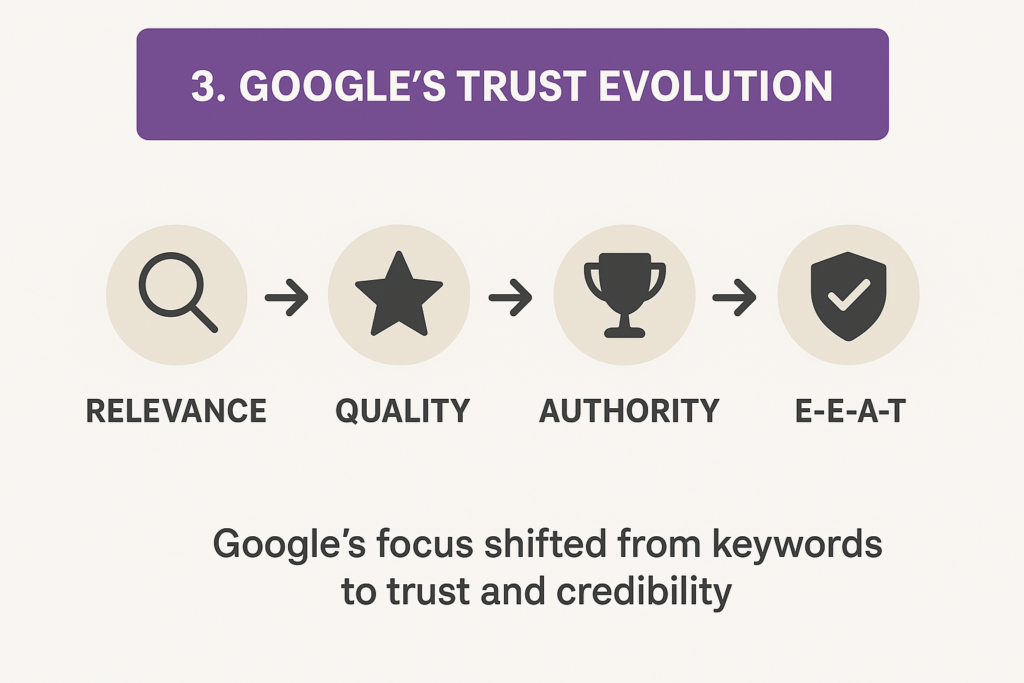
As search results got more accurate, checking how trustworthy a source is became even more important. To handle this, Google created a framework to measure authority, turning content creation into a process that values real expertise and trust.
3.1 The High-Stakes Standard: YMYL Content
Google defines certain topics as “Your Money or Your Life” (YMYL) areas like finance, health, law, and current events where false or misleading information can seriously affect someone’s safety, happiness, or financial well-being.
Content in these categories faces much stricter quality checks from Google’s Quality Raters. While these raters don’t directly change rankings, their feedback helps Google improve algorithms to prioritize trustworthy and accurate information.
For example, a health website without verified author details or credible references is likely to be rated as low quality.
While Google does not publish exact annual counts of how many sites are “impacted” by YMYL policies specifically, some estimates for SEO penalties or deindexing give a sense of scale:
- In 2017, nearly 6 million websites received penalty notifications via Google Search Console.
- Some studies show that for YMYL keyword clusters, a large share triggered AI Overviews (50%+ for certain health/legal topics) in research.
Because YMYL topics require higher quality and trust, sites in these categories often face more scrutiny and greater risk of traffic loss if they fall short on expertise, authority and trustworthiness.
3.2 Demonstrating Credibility: The E-E-A-T Framework
The mechanism Google uses to evaluate content credibility is the E-E-A-T framework, introduced in its Quality Rater Guidelines. E-E-A-T stands for:
- Experience: The creator must demonstrate first-hand or life experience relevant to the topic. For example, a product review should be written by someone who has actually used the product.
- Expertise: This reflects the author’s level of knowledge or skill in the specific subject matter.
- Authoritativeness: The degree to which the website or author is recognized and respected as a trusted, go-to source in the industry.
- Trustworthiness: Assesses the accuracy, honesty, and reliability of the website and its content, which is crucial for safety and fact-checking.
Demonstrating E-E-A-T requires a commitment to rigor. Content should be based on thorough research, cite authoritative external sources, and clearly showcase the author’s credentials. This framework is Google’s institutionalized response to the digital misinformation crisis, ensuring that critical information is sourced from verifiable experts. As SEO veteran Wendy Piersall suggested, the fundamental truth remains: “Google only loves you when everyone else loves you first”. Building E-E-A-T is thus a long-term strategy centered on building genuine reputation.
4. The AI Era: Helpful Content and the Conversational Web (2022–Present)
The current phase of SEO content evolution is defined by two forces: the immense power of advanced AI models (BERT and MUM) and Google’s aggressive countermeasure to filter mass-produced content (the Helpful Content System).
4.1 Understanding Context: BERT, MUM, and NLP
Google’s use of Artificial Intelligence (AI) and Natural Language Processing (NLP) has completely changed how search understands content. The 2019 BERT update helped Google better interpret natural, conversational queries, especially small but important words like “for” and “to,” which can change the meaning of a sentence.
In 2021, Google introduced the Multitask Unified Model (MUM), an AI system said to be 1,000 times more powerful than BERT. MUM is multimodal, meaning it can understand and connect information across text, images, and even video or audio — and it works across 75 languages. This makes it possible for Google to answer complex, multi-step questions that once needed several searches.
For content creators, MUM changes the game. It’s no longer enough to target a single keyword. Instead, creators need to build rich, in-depth content that answers follow-up questions, connects related topics, and shows a complete understanding of the subject.
4.2 The Helpful Content System (HCU): Google’s Mandate for “People-First” Content
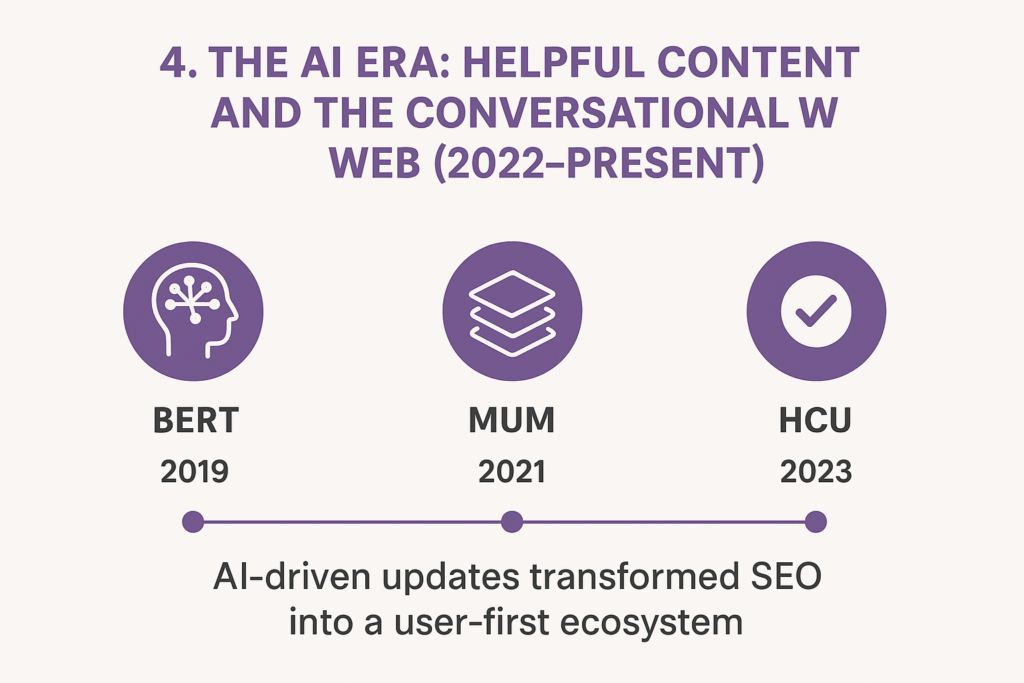
With the rise of quick, low-effort AI writing tools, the internet became flooded with generic and repetitive content. To fight this decline in quality, Google introduced the Helpful Content System (HCU) in August 2022, which has been updated several times since.
The HCU focuses on identifying content made mainly for search engines such as articles written to hit a certain word count or those chasing trending topics without real expertise or intent to help readers. Sites that publish a lot of unhelpful or unoriginal content have seen major traffic drops, sometimes over 40% after the 2023 and 2024 updates.
Importantly, HCU works as a site-wide signal, meaning if a large portion of your site is low-quality, your whole domain’s visibility can suffer. This has pushed SEO professionals to regularly audit and improve their content updating old posts, removing filler, and focusing on original, genuinely helpful information.
In short, Google’s goal is to highlight authentic, experience-driven content (E-E-A-T) and filter out articles that are just rewritten or AI-spun versions of existing material.
4.3 Content Structure in the AI Era: From Keywords to Topic Clusters
To establish comprehensive topical authority in this complex algorithmic environment, content creators are adopting structured organization models. The Topic Cluster model is now standard practice, connecting related articles (cluster pages) to a central pillar page that provides a broad overview of the core subject.
This structure is effective because it:
- Signals Authority: It tells search engines the website covers a topic comprehensively and deeply.
- Improves Crawlability: It enhances internal linking, distributing authority across the site.
- Matches Intent: Cluster pages target long-tail, specific queries (often informational or commercial intent), providing detailed answers while the pillar page addresses the broader term.
The move toward topic clusters reflects the necessity of proving site-wide expertise, supporting both the E-E-A-T and HCU mandates.
Also Read: The New Search Era: Google I/O’s Insights for Website Owners and Online Stores
5. The Modern Content Mindset: Strategic Approaches and Multimodal Optimization
The modern SEO content approach demands a strategic commitment to user satisfaction across all media and interfaces.
5.1 Mindset Shift: Writing for Humans, Optimizing for Algorithms
The key to SEO success today lies in a “people-first” content mindset. Every piece of content should exist because it’s genuinely useful to an audience — not just to fill a word count or chase rankings. This means focusing on original reporting, unique insights, and complete, well-explained information that truly helps users solve their problems.
The main goal is user satisfaction. Great content leaves readers feeling informed and confident, without needing to look elsewhere for answers. Google often measures this through signals like bounce rate and time on page if users leave too quickly, it’s a sign the content didn’t deliver real value.
In the end, SEO success isn’t only about traffic numbers it’s about organic conversions that prove your content met the user’s intent. As SEO expert Dave Davies put it, “Content is what the search engines use to fulfill user intent.”
The Evolution of SEO Content Strategy: Mindset Shift
| Old Approach (Keyword Era) | Modern Approach (Intent & E-E-A-T) | Driving Metric |
| Focus on exact keyword density | Focus on comprehensive topic coverage (clusters) | Topical Authority |
| Writing to fulfill a specific word count | Writing to thoroughly answer the user’s problem | User Satisfaction (Time on Page/Bounce Rate) |
| Content created quickly for ranking (Search Engine-First) | Content created to demonstrate first-hand experience (People-First) | E-E-A-T Score |
| Ignoring user experience and page speed | Optimizing for mobile, accessibility, and site speed (UX/SEO alignment) | Dwell Time & Conversions |
5.2 Optimization for Multimodal and AI Search
The SERP has moved beyond the traditional “10 blue links” to incorporate dynamic, summarized features like AI Overviews and video carousels. This necessitates a multimodal content approach.
Conversational Search and Position Zero
Voice search queries are typically longer and more conversational, often taking the form of questions (e.g., beginning with “how,” “why,” or “what”).To capture visibility in these results, content must be structured to provide direct answers. This means optimizing for Position Zero (Featured Snippets), using simple language, short sentences, and structured formatting like FAQ sections or bulleted lists, followed immediately by a concise answer.
Visual and Video SEO
As AI models like MUM become multimodal, content must be optimized across text, image, and video. Video SEO is critical because visual content typically increases user engagement and dwell time, positively impacting metrics that algorithms use to assess quality. Video should be treated as high-value content, requiring optimized metadata, titles, and clean URL structures for proper indexing. Video is also essential for demonstrating the “Experience” component of E-E-A-T.
Adapting to AI Overviews
Google’s introduction of AI Overviews (May 2024) fundamentally reshaped how information is delivered through AI-driven summaries. To appear as a source cited by AI, content must be highly structured, technically clean, and easily parsed by machine learning models. SEO fundamentalslike E-E-A-T and relevance—remain crucial for success, as AI systems rely on the most trusted sources to generate their answers. The future of visibility lies in adapting content to become the authoritative source that AI trusts to summarize a topic.
Conclusion: Content is Constant, SEO is the Conduit
The journey of SEO content, spanning from keyword density in the late 1990s to the current era of Helpful Content and AI scrutiny, demonstrates a continuous upward trajectory in quality standards. Every major algorithmic update, from Panda targeting thin content to HCU filtering unhelpful mass-production, has systematically reinforced the requirement for high-quality content.
The most effective SEO strategy today is deeply intertwined with content strategy, demanding an approach that is audience-first and authority-driven. Content creators must commit to providing originality, demonstrating first-hand E-E-A-T, and solving user queries more thoroughly than competitors.
While the technical aspects of SEO ensure this valuable content is found, the long-term success of any domain rests on the value derived from the human experience and expertise behind the content. In an age where generic content can be generated instantly by AI, authentic, comprehensive, and helpful content possesses a unique competitive advantage.
Happy Reading…
Also Read: The SEO Myth Why It Never Dies and Always Evolves