
I’ve seen talented teams miss deadlines despite having all the right skills on paper.
I’ve seen brilliant employees struggle to work together. I’ve seen managers spend months trying to fix performance issues through new tools, new processes, and endless meetings, only to realize the real problem wasn’t the work itself.
It was how people worked differently.
Over the years, while leading SEO initiatives, collaborating with cross-functional teams, and managing people with different strengths and working styles, one thing became clear to me:
Teams don’t succeed or fail based on skills alone. Personality plays a bigger role than most organizations realize.
This is where the OCEAN model comes in.
No, it isn’t another trendy personality quiz.
It’s one of the most widely researched frameworks in psychology, often referred to as the Big Five personality traits. More importantly, it offers managers and leaders a practical lens to understand how people think, communicate, handle pressure, adapt to change, and contribute to a team.
And when used responsibly, it can completely change the way organizations build and lead teams.
Why Good Teams Still Struggle
Most organizations are great at assessing technical skills.
- They evaluate experience.
- They test competencies.
- They review certifications.
But They Rarely Ask Questions Like…
How does this person respond to feedback?
Do they thrive in ambiguity or prefer structure?
How do they collaborate during conflict?
What motivates them?
How do they react under pressure?
The result?
You hire highly capable individuals who don’t work well together.
The issue isn’t competence. It’s compatibility.
I remember working with people who were exceptional at generating ideas but struggled with execution. Others could execute flawlessly but resisted experimentation. Neither group was wrong. They simply approached work differently.
Instead of viewing these differences as problems, organizations can learn to understand and leverage them.
What Is the OCEAN Model?
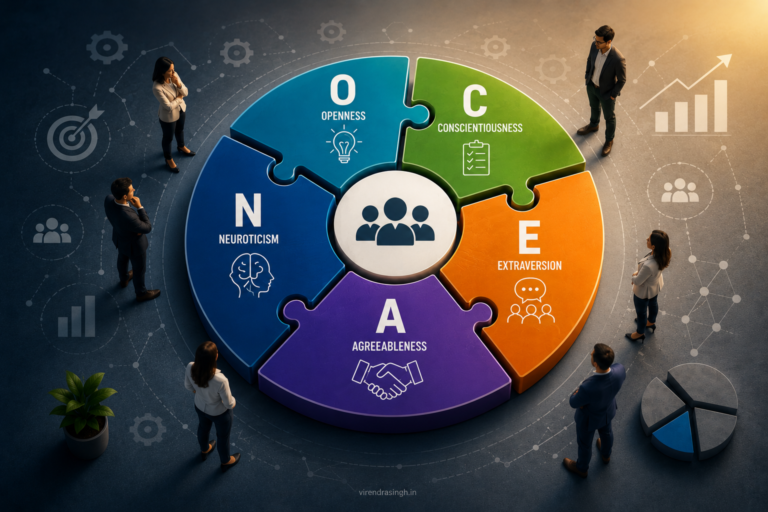
The OCEAN model describes five broad dimensions of personality:
The Five OCEAN Personality Traits
The OCEAN model helps understand how people think, behave, communicate, and respond in different situations.
🌊 Openness
How comfortable someone is with new ideas, creativity, and experimentation.
📋 Conscientiousness
The tendency to be organized, dependable, and disciplined.
🗣️ Extraversion
The preference for social interaction, energy from people, and outward expression.
🤝 Agreeableness
How cooperative, empathetic, and accommodating someone tends to be.
🧠 Neuroticism
The tendency to experience stress, worry, or emotional sensitivity.
It’s important to remember that these aren’t labels.
People don’t fit neatly into boxes.
Instead, these traits exist on a spectrum, helping us understand tendencies rather than defining identities.
A Team Isn’t Broken. It May Just Be Unbalanced
One of the biggest misconceptions in organizations is the belief that hiring more people like your top performer will automatically create a stronger team.
In reality, balance often beats similarity.
Imagine a team made entirely of highly creative individuals.
They generate incredible ideas.
Brainstorming sessions are exciting.
Innovation flourishes.
But execution becomes inconsistent.
Now imagine the opposite.
Everyone is highly structured and detail-oriented.
Projects move efficiently.
Processes are documented.
Deadlines are met.
But innovation slows down.
The strongest teams I’ve observed weren’t made up of identical personalities.
They combined different strengths.
Some challenged assumptions.
Others created stability.
Some pushed ideas forward.
Others ensured those ideas actually got implemented.
That’s where the real magic happens.
The Marketing Team Example I Know Well
Coming from an SEO and digital marketing background, this became obvious to me very early in my career.
A technical SEO specialist often thrives on systems, audits, and structured problem-solving.
A content strategist may naturally enjoy exploring ideas, audience psychology, and creative approaches.
An outreach specialist may gain energy from relationship-building and communication.
A performance marketer may constantly experiment with campaigns and data.
Each role demands different strengths.
The mistake many leaders make is expecting everyone to think and work the same way.
They compare people using one standard.
But different jobs often require different approaches.
The goal isn’t uniformity.
The goal is alignment.
Leadership Isn’t One-Size-Fits-All
This was one of the hardest lessons for me as a manager.
Early on, I assumed that the way I preferred to communicate and work was simply the “right” way.
Over time, I realized that effective leadership requires flexibility.
Some employees appreciate direct feedback.
Others need context and encouragement before difficult conversations.
Some prefer autonomy.
Others value regular check-ins.
Some think out loud during meetings.
Others process information quietly before contributing.
If leaders ignore these differences, misunderstandings increase.
If they recognize them, trust grows.
The standard should remain the same.
The approach doesn’t have to.
Conflict Isn’t Always About Bad Intentions
Think about how many workplace conflicts begin with assumptions.
“She’s too blunt.”
“He never speaks up.”
“They resist every new idea.”
“Why do they overthink everything?”
Often, what we interpret as difficult behavior is simply a difference in personality.
One person values harmony.
Another values honesty.
One prefers quick decisions.
Another needs time to evaluate risks.
Neither approach is automatically right or wrong.
Understanding these tendencies doesn’t eliminate conflict.
But it changes the conversation from blame to understanding.
And that shift alone can transform team dynamics.
Change Management Through a Different Lens
Organizations today are constantly evolving.
New Technologies
AI Tools
Process Changes
Digital Transformation Initiatives
Yet leaders are often surprised when employees react differently.
Some embrace change immediately.
Others hesitate.
Some ask dozens of questions.
Others quietly worry about what it means for their future.
I’ve seen this happen repeatedly.
The mistake is assuming resistance means negativity.
Sometimes people simply process uncertainty differently.
Leaders who recognize these differences communicate more effectively.
They anticipate concerns instead of reacting to them.
And change becomes something people navigate together rather than something forced upon them.
Burnout Doesn’t Look the Same for Everyone
This is another area organizations often overlook.
Burnout isn’t always about workload.
It’s also about how people experience work.
Some employees push themselves relentlessly because they don’t want to let others down.
Some become overwhelmed by uncertainty.
Others struggle when isolated from social interaction.
I’ve seen high performers quietly exhaust themselves because nobody noticed the pressure they placed on themselves.
The signs aren’t always obvious.
Understanding individual tendencies can help managers identify risks earlier and create healthier work environments.
Because supporting people isn’t just about improving productivity.
It’s about sustaining it.
A Word of Caution: Don’t Use Personality to Label People
This may be the most important part of the conversation.
The OCEAN model isn’t a crystal ball.
It shouldn’t determine promotions.
It shouldn’t decide who deserves opportunities.
And it should never be used to put employees into fixed categories.
Personality insights are tools for understanding.
Not judgment.
People grow.
People adapt.
Context matters.
A person who struggles in one environment may thrive in another.
The goal isn’t to predict human behavior with certainty.
The goal is to ask better questions.
So, How Can Organizations Actually Use This?
From a practical perspective, I believe the sequence matters.
Many organizations start with personality assessments.
I think that’s backwards.
A better approach looks like this:
How Organizations Can Apply the OCEAN Model
Understand the Role
What outcomes define success?
Identify Behavioral Demands
What behaviors support those outcomes?
Gather Personality Insights Ethically
Use assessments transparently and responsibly.
Build Complementary Teams
Focus on balance rather than similarity.
Adapt Leadership Practices
Adjust communication and coaching styles.
Monitor Outcomes
Evaluate engagement, collaboration, and performance.
Reassess Over Time
Teams evolve. So do people.
When used this way, personality becomes a development tool rather than a selection tool.
The Hidden Operating System of Teams
Organizations invest heavily in technology.
They optimize processes.
They track KPIs and dashboards.
All of these things matter.
But behind every process is a person.
Behind every strategy is a team.
And behind every team’s performance lies a set of human differences that often go unnoticed.
I’ve come to believe that great leaders aren’t necessarily the smartest people in the room.
They’re the ones who understand how different people contribute, communicate, adapt, and thrive.
The OCEAN model won’t solve every organizational challenge.
But it can help managers see their teams more clearly.
And sometimes, seeing people clearly is where transformation begins.
Because high-performing organizations aren’t built by finding one perfect type of employee.
They’re built by creating environments where different kinds of people can do their best work together.
And perhaps that’s the hidden operating system of every successful team.