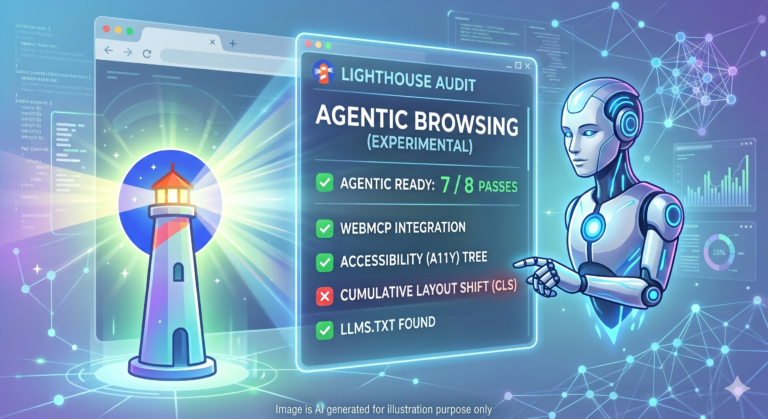
The web is evolving from a space built exclusively for human readers to one actively navigated by AI agents. To help developers and search professionals adapt to this shift, Google Lighthouse has introduced the experimental Agentic Browsing category.
This new audit evaluates how effectively machine interfaces—like AI assistants, large language models, and automated tools—can interpret and interact with a website.
Here is a breakdown of how the scoring mechanics work, what Lighthouse is looking for, and how to optimize your technical foundation for the agent-driven web.
How Agentic Browsing Scoring Works
Unlike traditional Lighthouse metrics that assign a standard 0 to 100 grade, Agentic Browsing scoring currently takes a different approach. Because the standards for machine-to-web interactions are still emerging, the tool focuses on providing actionable, deterministic signals rather than a definitive ranking.
Instead of a traditional grade, the report delivers:
- A Fractional Score: A straightforward ratio displaying how many agent-readiness checks the site passes.
- Pass or Fail Statuses: Specific alerts indicating if technical requirements, such as WebMCP schema validity, are not met.
- Informational Counts: A top-level pass ratio to help teams track overall technical progress at a glance.
Why Audit Results Can Fluctuate
Site owners might notice variability in their audit results from test to test. While the checks themselves are deterministic, dynamic site behaviors can shift the outcome:
- Dynamic Tool Registration: If a site uses JavaScript to register WebMCP tools imperatively, the timing of that execution might miss the exact window when Lighthouse takes its snapshot.
- Accessibility (A11y) Tree Shifts: Changes in DOM size or structural complexity alter the accessibility tree. Since agents use this tree as their primary map of the page, fluctuations here directly impact the score.
- Cumulative Layout Shift (CLS): Visual stability is critical for machines as well as humans. If elements jump around due to late-loading ads or unmeasured images, an AI agent might misinterpret element positioning and fail to interact properly.
The Core Pillars of the Audit
Lighthouse evaluates agentic readiness across three main technical pillars, ensuring the site is reproducible and stable enough for CI/CD pipelines.
- WebMCP Integration: The audit monitors tool registration events via the Chrome DevTools Protocol. It verifies both declarative tools (defined directly in the HTML) and imperative tools (executed via JavaScript).
- Agent-Centric Accessibility: AI agents do not visually “see” a page; they read its accessibility data. Lighthouse checks that all interactive elements have programmatic names, verifies valid parent-child structural relationships, and ensures essential elements are not hidden from the accessibility tree.
- Stability and Discoverability: Elements must remain stationary for agents to interact reliably, making CLS a vital performance metric. Additionally, Lighthouse looks for an
llms.txtfile at the root domain—a machine-readable summary that helps agents quickly grasp the site’s purpose and navigation paths.
Steps to Optimize for Machine Interaction
To align your digital properties with the demands of AI agents, focus on these fundamental practices:
- Implement WebMCP APIs: Use WebMCP to explicitly expose your site’s logic and forms to AI agents, streamlining their ability to interact with your database or services.
- Fortify Semantic HTML: Build a robust accessibility tree using proper semantic HTML and strict ARIA labeling. Treat the accessibility tree as the true “machine-eye view” of your page.
- Lock Down Layout Stability: Eliminate unexpected layout shifts. A stable interface ensures that when an agent attempts a targeted interaction, the element is exactly where the machine expects it to be.
Preparing for AI agents is a natural extension of strong technical SEO and accessibility practices. By optimizing for machine-readability today, you ensure your architecture is ready to be parsed, understood, and navigated by the next generation of digital tools.
Also Read: The Evolution of SEO Content: From Keyword Stuffing to AI-Powered Authority
Editorial Note: While AI tools were used to assist in drafting certain elements of this article, the final content has been thoroughly reviewed, edited, and fact-checked by virendra singh to ensure accuracy and quality before publication.