
Google’s approach to content quality goes beyond keywords, backlinks, and SEO optimization. Its official Creating Helpful, Reliable, People-First Content documentation explains how creators can evaluate whether their content is useful, original, reliable, and created for people.
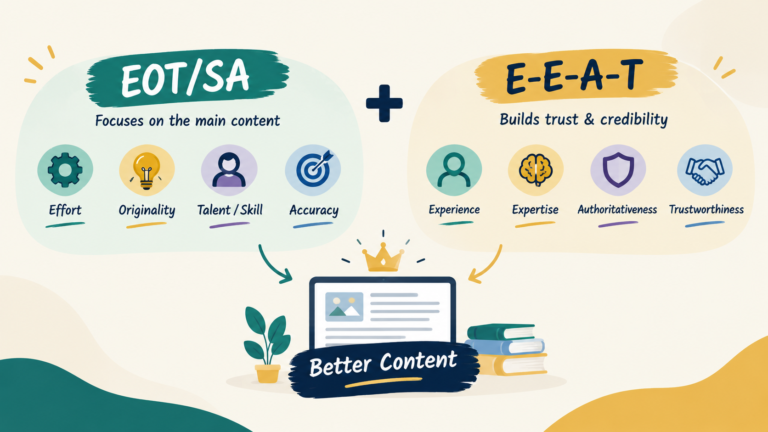
Along with E-E-A-T, Google highlights four important attributes for evaluating the main content: Effort, Originality, Talent or skill, and Accuracy. We can use EOT/SA as a simple way to discuss these four attributes.
Let’s understand how they work and how they complement E-E-A-T.
What Is EOT/SA in Content Quality?
EOT/SA refers to four attributes that help us evaluate the quality of the main content on a webpage. These are not a replacement for E-E-A-T but another useful way to understand what makes content valuable.
1. Effort: How Much Work Goes Into the Content?
Effort is about the actual work involved in creating content. Simply publishing an article is not enough. The research, analysis, editing, testing, and original work behind it also matter.
For example, publishing an article by combining information from different websites without adding anything useful shows limited effort. On the other hand, conducting original research, analysing data, interviewing experts, or sharing practical insights adds more value.
AI can help with content creation, but publishing large amounts of automatically generated content without proper review or improvement may show little effort.
2. Originality: Does the Content Offer Something New?
Originality means providing information, insights, or perspectives that are not already available everywhere.
Rewriting an existing article in different words does not automatically make it original. Readers should get something useful from your content that they cannot easily find in the same form elsewhere.
This could be your own analysis, first-hand experience, a case study, original data, or a different explanation of a complex topic.
The objective is simple: give readers a reason to choose your content over other available sources.
3. Talent or Skill: Is the Content Created Well?
Talent or skill refers to the ability to create content that serves its purpose and provides a satisfying experience.
For a blog, this could mean clear writing, a logical structure, useful examples, and an easy-to-understand explanation. For a video, it could mean good presentation and editing. For a tool, it could mean useful features that work properly.
Not every topic requires a specialist, but the creator should have the skills needed to deliver what the audience expects.
4. Accuracy: Is the Information Correct?
Accuracy is about providing factually correct and reliable information.
A well-written article can still be poor quality if it contains incorrect facts, outdated information, or misleading claims.
For example, a publisher covering SEO updates should verify information from official sources before presenting it as a confirmed Google update.
Accuracy becomes even more important for topics related to health, finance, safety, and other areas that can significantly affect people’s lives.
What Is the Difference Between EOT/SA and E-E-A-T?
E-E-A-T stands for Experience, Expertise, Authoritativeness, and Trustworthiness. It helps us understand why readers should trust the content and its creator.
Here is a simple comparison:
- EOT/SA: Focuses on the effort, originality, skill, and accuracy demonstrated in the main content.
- E-E-A-T: Focuses on experience, expertise, authority, and trust associated with the content and its source.
For example, imagine two websites publishing articles about the same Google algorithm update.
The first website publishes a rewritten article with no additional insights, limited verification, and unclear explanations.
The second website verifies the update using official documentation, adds its own analysis, explains the impact with examples, and clearly identifies the author.
The second article demonstrates stronger content quality through effort, originality, skill, and accuracy. Its author information, demonstrated knowledge, and reliable sourcing can also help readers assess its E-E-A-T.
Both perspectives help us evaluate different but connected aspects of content quality.
How Can Both Work Together?
E-E-A-T and the four main-content attributes should not be treated as competing frameworks.
A website may have an experienced author and a strong reputation, but that does not automatically make every article useful or accurate. Similarly, an original and well-written article may still lack clear sourcing or sufficient evidence to establish trust.
Publishers should therefore work on both sides.
Invest time in research, add original insights, present information clearly, and verify facts. At the same time, demonstrate relevant experience, establish expertise, build authority through reliable work, and make it easy for readers to understand who created the content.
Google also clarifies that E-E-A-T itself is not a specific ranking factor. Its automated ranking systems use a variety of signals to identify helpful content, and search quality raters provide feedback on how well those systems work.
Final Thoughts
Content quality is not about following one checklist or adding an author’s name to every article. It is about creating content that genuinely helps people.
EOT/SA gives us a practical way to review the work behind the content, while E-E-A-T helps us think about experience, expertise, authority, and trust.
The takeaway for publishers is simple: create content with real effort, original value, the right skills, and accurate information — while building genuine trust in the people and website behind it.
Both perspectives can help you create better content for your audience.
Also Read: What to Check When GA4 Suddenly Shows Zero Real-Time Users